
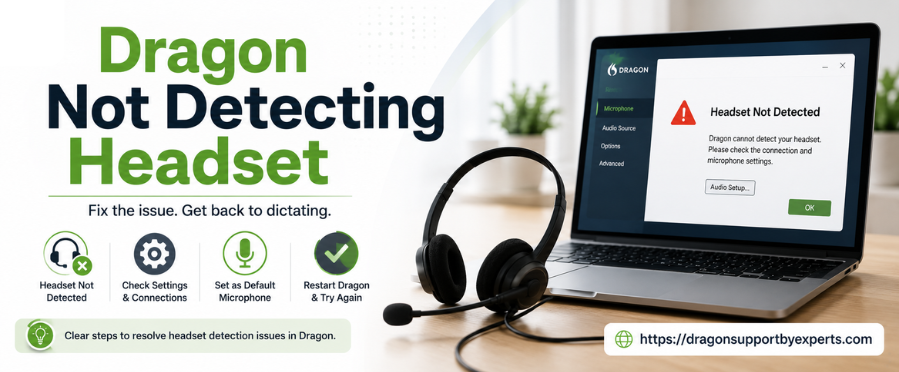
If you are ready to wind up all your tasks within a few hours, but Dragon Not Detecting Headset then you have already encountered a major problem. It is one of the issues Dragon users occasionally complain about. It happens for various reasons, including outdated drivers, audio settings, hardware connection issues, and more. Even if it is a common issue, the solution must be readily available to users so they can resolve it at any time. Today, this guide will be based on the same one and will also cover other things that will help you along the way or afterward. Stay tuned to know further.
Why Is Dragon Not Detecting Headset?
If Dragon Not Detecting Headset, there could be multiple reasons. Here are some of them:
- The headset is not properly connected to the system.
- The user has not selected the microphone as the default recording device.
- Windows microphone permissions are disabled.
- Dragon Naturally Speaking needs a proper audio setup or a microphone recalibration.
- There is a malfunction in the USB port or Bluetooth connection.
- Dragon Naturally Speaking is set up in such a way that it uses a different kind of audio device.
- The headset microphone is turned mute or disabled.
- Presence of another application controlling or blocking access to the microphone.
- There is a fault in the hardware, or it is damaged.
Signs Indicating Dragon NaturallySpeaking Is Unable To Detect The Headset
Here are some of the signs mention below indicating Dragon Not Detecting Headset:-
- There is no response from Dragon Naturally Speaking to your voice.
- The microphone icon will remain inactive or grayed out.
- No audio input will be detected while speaking.
- The headset will not appear in the audio device list.
- The microphone setup wizard will be unable to detect the headset.
- Dictation cannot convert speech into text.
- Voice commands do not get any recognition or execution.
- An error message will pop up on your screen related to a missing or unavailable microphone.
- Audio levels will not move while speaking into the headset.
- Dragon repeatedly asks to configure or connect to a microphone.
How To Fix The Headset is Not Working Issue?
Here are some steps you can take to resolve the issue of Dragon Not Detecting Headset. Have a look at them one by one:-
Zero Signal Related To Audio
- Do check your “Microphone Mode”.
- First, check whether your microphone is “Turn On”; the microphone button in the status window should always remain green.
- If the button is “Red”, your microphone is “OFF”. Click the button in order to turn on the “Microphone”.
- If the microphone button is not turning “Green”, it means your microphone is not connected properly.
Do Check Your Connection
- Ensure the microphone you have selected is properly connected to your computer. If you are unable to decide which microphone you have selected, just click on the Dragon menu icon in the menu bar and select Manage Profiles. Now look under dictation sources. The microphone you have selected should be mark with a green dot. If any microphone is missing, it will be marked with a warning icon (Microphone disconnected warning).
If your microphone is missing , do any of the following:-
- Select another microphone from the “Dictation Sources Panel”, then click “Load”. If there is no alternative audio source listed, click on the “Add Audio Source icon” right under the dictation.
- Now “Unplug” the microphone, then “Plug it back in”. If you are using a USB microphone, make sure it is plugged directly into your “computer”, not into a “USB hub”.
- If it is a Bluetooth microphone, Go to System “Preferences>Bluetooth” and ensure that Bluetooth is “Turned on” for your computer and that your microphone is properly connected.
Check Microphone Settings
If there is no missing microphone icon (Microphone disconnected warning) next to your microphone, look for problems with the microphone itself.
- In the “Apple menu”, select “System Preferences”.
- Click “Sound” (sound screen will open).
- Click the “Input tab”.
- Ensure the microphone appears in the listed devices (if your microphone is not appearing in the sound preferences, it will not work in any of the applications).
- Make sure the microphone that you have configured with Dragon is selected and then speak into the microphone.
You should look at the input level indicator in order to respond to the sound of your voice. If it does not respond, there might be a problem with your microphone.
- Check whether your microphone has a “Mute” switch or not. If it has , make sure the Mute switch is “off“.
- If you are using a Bluetooth microphone, ensure it is properly turned on and fully charged too.
- If your microphone can be turned off, try “Restarting it”.
- Try to use your microphone with a different computer or device.
Try To Restart
- You can try to restart Dragon
- Click on the Dragon “Menu icon” from the menu bar and select Quit Dragon.
- Head to the application folder and double-click on “Dragon”.
Lack of good audio quality
If the dragon can hear your voice but cannot recognize it, then there is a major issue with the quality of your audio input.
Check your microphone quality
Make sure the microphone is positioned properly, and do not move it away from its original position while running your microphone setup.
Recalibrate your microphone
- To determine whether your microphone is properly calibrate for your voice and environment, go through the microphone setup for each profile and each dictation source you use.
- If your audio input level (gain) is very high or low, you can adjust the microphone setup around the clock by clicking the Dragon menu icon on the menu bar and selecting Improve “Recognition>Microphone setup”.
Reduce the background noise
To have the best recognition, always look for ways to minimize background noise. Many microphones have noise-canceling capabilities that help filter out background noise.
Listen to your audio
If the above-mentioned steps do not resolve the issue, try using the dictated audio.
- Dictate some of the text into a document.
- Say “select<text>”,or “select all.”
- Say “Play the selection.”
If you are experiencing any gaps in the audio or interference, such as a crackling sound, your microphone is the root cause.
- If you have to plug in your microphone to your computer, simply check the connection. Now try unplugging the microphone and plugging it back in. If you are relying on a USB microphone, ensure it is plugged directly into your computer and not a USB hub.
- If you are taking the help of a Bluetooth microphone, make sure it is charged properly.
- Try to use the microphone with a different computer or device, if possible.
Try to use a different microphone.
| Note – If you are connecting a new microphone, do run a microphone setup. |
Poor Recognition
If the audio quality is good but Dragon is unable to recognize your voice, you can follow the steps below.
Check your profile
If you use multiple profiles on your computer, ensure the correct user profile is open.
- Click on the Dragon menu icon in the menu bar and ensure that your profile is showing a check mark next to it.
- If there is a different profile that is showing the check mark, simply select the recent profile list. If you are unable to see your profile, click Manage Profile, then select and load your profile in the profile pane.
Voice training
Proper voice training ensures better results. Voice training helps Dragon learn your speech patterns, intonations, and accent.
- To start the voice training , click on the Dragon menu icon in the menu bar and select Improve Recognition> Voice Training.
Vocabulary training
Vocabulary training teaches the dragon on how you use language. Select one or more text files that you have written, and Dragon reads your text in order to analyze what kind of words you use and when and how often you use them
- To start the vocabulary training , click on the Dragon menu icon in the menu bar and select Improve Recognition> Vocabulary Training
| Note – If you are struggling with recognition on any particular word, just go to the vocabulary editor in order to train Dragon to understand how you pronounce specific words. |
Recreate The Dictation Source
In some cases, recreating the dictation source can improve recognition. This will help you in preserving all of your custom vocabulary and commands, while allowing Dragon to improvise on how it recognizes your voice
- Click on the dragon menu icon in the menu bar and then select manage profiles.
- Now select your profile in the left column.
- Now click on the add button under the dictation sources.
- Now in the microphone drop-down list, select the same microphone that you are currently using and give it a unique name.
- Now click on continue.
- Now complete the microphone setup. This step can take up to 5 minutes.
Tips To Prevent Headset Detection Issues
- Do connect the headset properly before launching Dragon Naturally Speaking.
- Take the help of a compatible and high-quality headset for better performance.
- Do update the audio driver on a regular basis.
- Make sure the Windows microphone permissions are enable.
- Do not switch the audio devices when Dragon is on run.
- If you have installed or updated the audio driver , restart the system.
When To Contact Dragon Support?
If you are unable to detect the headset after trying all basic troubleshooting steps, you must contact Dragon Support. If the microphone is working in other applications but not in Dragon NaturallySpeaking, or if the audio process is failing or showing an error. Support is required.
Conclusion!
Dragon Not Detecting Headset, then it is simply emerging from simple configuration or connection problems. If you check the hardware connection , update the driver, and set up the audio devices properly, you can resolve the issue easily. If the problem persists even after troubleshooting, contact Dragon support to ensure smooth voice recognition performance.
FAQs
A. It happens due to incorrect audio settings, outdated drivers, disconnected hardware, or disabled microphone permission in Windows.
A. To do so, simply check the headset connection, set it as the default device, run the microphone setup wizard, and make sure Windows permissions are enabled.
A. It supports most USB and wired headsets, but compatibility may vary depending on the drivers and system configuration.